


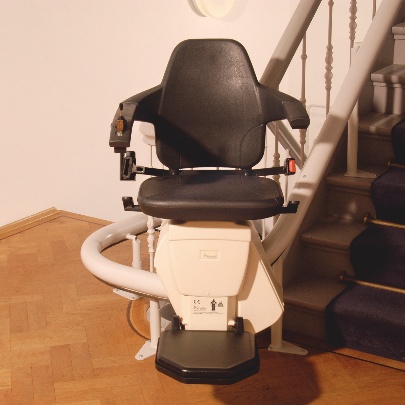
As an imported home mobility aid, chairlifts have become an essential assistive device for the elderly in an increasing number of Chinese and Asian families over the past decade. For consumers, the primary users of chairlifts are the elderly, making safety the top priority. However, chairlifts are not yet included in the “Special Equipment” list in China or other Asian countries, lacking mandatory inspection or 3C certification, and the industry has not formulated any technical safety standards specifically for chairlifts. For example, in China, only GB/T 24806-2009 “Stairlifts for People with Disabilities,” which officially came into effect in 2010, is currently the closest national standard to a “dedicated standard for chairlifts,” but it is only a recommended standard. Without mandatory national standards or strict industry technical testing standards, it is impossible to comprehensively regulate and supervise products from the perspective of enterprise production responsibility. Concerning the health and safety of family members, consumers always have safety concerns. Are there higher international certification standards that users can refer to? Of course!
The EU EN 81-40:2020 Safety Standard
The most important and authoritative international safety certification for chairlifts (i.e., stairlifts) is the EU EN 81-40:2020 standard. This standard sets the most stringent requirements for a range of mechanical structural and functional designs, including guideway stability and mechanical emergency braking, rack and pinion systems and overspeed detection, drive systems and units, electrical safety, signaling and warning devices, design verification, and testing.
North American ASME A18.1 Safety Standard
ASME A18.1-2023 is a safety standard for platform lifts and stairlifts published by the American Society of Mechanical Engineers. This standard provides clear implementation guidelines for materials and manufacturing, equipment drive design, ramps and protection, electrical equipment and wiring, structural support, and installation and maintenance.
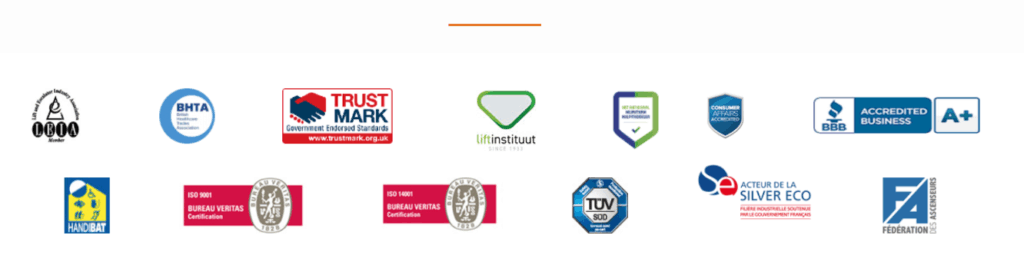
EN 81-40:2020 and ASME A18.1 are mandatory safety requirements for chairlifts. Before entering the market, chairlifts must undergo testing and certification by leading independent global testing organizations. These include the Dutch Elevator Association (Liftinstituut), the British Standards Institution (BSI), and the German Association for Technical Inspection (TÜV).
ISO 9001 Quality Certification and ISO 14001 Environmental Certification
Besides product safety and quality being crucial indicators, manufacturers need to consider both customer demands for quality and the requirements of social sustainability. This requires implementing a series of measures in the construction of production and energy use combinations to achieve product upgrades, business development, and environmental protection—the cornerstone of consumer trust in the brand and its products.
Taking Handicare chairlifts as an example, Handicare chairlifts have obtained all certification standards, including EU EN 81-40:2020, North American ASME A18.1, the Liftinstituut, the British Standards Institution (BSI), the German Technical Inspection Association (TÜV), and ISO. This means that choosing Handicare chairlifts means choosing products that meet the most stringent quality and safety standards in the industry.
Handicare chairlifts have been in the Chinese market for over a decade, adhering to the principles of higher quality, continuous innovation, and customer-centricity to promptly respond to and serve local customers. If you have any further questions regarding the safety certifications of chairlifts, please feel free to contact us.