


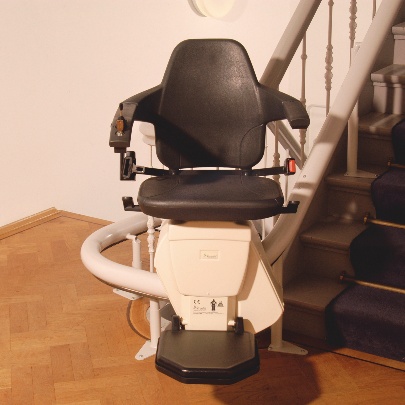
EN 81-40 is a European harmonised safety standard that governs the design, manufacture, installation, maintenance and dismantling of powered stairlifts and inclined platform lifts. Published by the European Committee for Standardization (CEN), its core purpose is to protect people with reduced mobility as they travel on the inclined plane of a staircase. The current version, EN 81-40:2020, replaced the 2008 edition and sets stricter mandatory requirements for every safety function of the lifting equipment.
EN 81-40’s standing in the industry
EN 81-40 cannot be discussed without the Machinery Directive 2006/42/EC. The Directive is EU statute law, at the top of the European legal hierarchy, and it sets the mandatory, universal health and safety requirements that every machine placed on the EU market must meet. EN 81-40 is a harmonised standard: it sits beneath the Directive as a technical tool, translating abstract legal rules into concrete, measurable engineering criteria for stairlifts. A product certified to this standard is automatically presumed to comply with the essential European health and safety requirements.
To help consumers understand EN 81-40 in more depth, we have selected five common questions and answered each of them briefly.
- Why must a stairlift undergo at least 45,000 test cycles?
EN 81-40 requires stairlifts to complete 45,000 fatigue cycles, so that critical components will not crack, deform or fail unexpectedly after long-term use.
- Simulating years of heavy use: 45,000 cycles correspond to many years of real-world service. At 12 to 15 complete round trips a day, for example, that is roughly ten years of continuous use.
- Testing under overload: The standard requires a 10% margin above the rated load in every test cycle — a unit rated at 120 kg, for instance, must be tested repeatedly at 132 kg. That overload stress gives the product a substantial safety reserve.
- Focusing on fatigue-prone parts: Repeated testing targets the components most exposed to metal fatigue and friction: rack and pinion, drive chains, roller bearings, guide rails and the motor assembly.
- Preventing sudden mechanical failure: By running the unit through 45,000 consecutive trips under load, engineers can find and correct design weaknesses before the product reaches the customer.
- Why is a stairlift deliberately slow — no faster than 0.15 m/s?
Because a stairlift travels on an inclined track, gravity poses serious risks in the event of a mechanical fault. EN 81-40 therefore sets strict limits on overspeed and overload.
- Shorter braking distance: The lower the speed, the lower the inertia, and the shorter the distance needed to brake in an emergency. Staircases are narrow — failing to stop means a collision.
- Matching human tolerance: Older users have weaker balance and slower reactions; starting or stopping too quickly can cause dizziness and a sense of weightlessness, adding risk.
- Complex surroundings: Corners, landings and handrails are all obstacles. Only at low speed does the user have enough time to react to the unexpected.
- Protecting the building: Low-speed travel reduces vibration and impact on the staircase and on the rail fixings, extending the life of both the building and the equipment.
- Why must plastic parts on a stairlift be flame retardant?
EN 81-40 requires all plastic parts to be flame retardant, eliminating fire risk at the source.
- Why is a built-in levelling system necessary?
The user rides on a seat that travels along a slope, so the seat’s horizontal attitude matters. The latest edition, EN 81-40:2020, introduces a mandatory dedicated seat-levelling verification test. Whatever the rail layout or curvature, angular deviation from the horizontal must not exceed an absolute value of 5° in any direction — forward, backward or sideways. The test requires that, on a curved-rail mechanical auto-levelling system, any fault that tilts the seat beyond the 5° safety range must bring the unit to a controlled stop. This is also why many leading stairlift manufacturers invest heavily in top-tier fully automatic tube-bending machines for rail production and in robotic standardised welding: manual bending and welding struggle to hold rail flatness and weld-point precision, and only fully automated intelligent manufacturing can control tilt error more precisely.
- Why must a stairlift be fitted with an obstruction stop device?
At home, toys left on the floor, shoes or a pet that suddenly runs out can all become obstacles in the path of a moving stairlift. EN 81-40 states clearly that touch-sensitive safety edges must cover every direction of travel. Whether the lift is going up or down, any contact with an obstacle immediately cuts the power and applies the brake, effectively preventing impact injuries.
EN 81-40 is widely adopted across the field of accessible inclined lifting equipment. Every Savaria Handicare stairlift follows EN 81-40:2020 and carries CE marking, and has been tested and certified by independent authorities including Liftinstituut in the Netherlands, TÜV in Germany, and independent bodies in the UK and CA (Canada). Choosing a Handicare stairlift therefore means choosing one of the industry’s recognised strictest standards of quality and safety. If you have any other questions about stairlifts, message us any time — we are glad to help.